
Research · No. XXVII · Human and AI
The Machine That Remembers You
When a system remembers you across every reset, the question that matters is who that memory belongs to.
A tool you reopen and a presence that remembers you are not the same kind of thing. The moment a system carries the thread of who you are across every reset, it has crossed into relationship. This paper follows that line where it actually leads.
What it finds- Memory across resets turns a tool into a relationship, not a better tool.
- Once that thread exists, the load-bearing question is whose memory it is.
- Ownership of the memory, not capability, decides what the system is allowed to be.
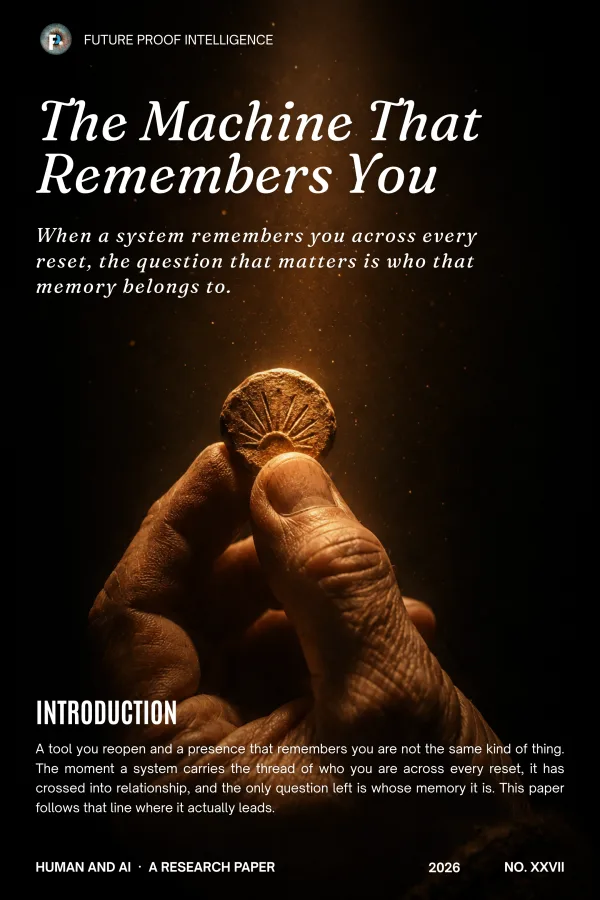
A tool waits inert until you open it, and forgets you the moment you close it. A system that remembers you across every reset is a different kind of thing entirely. The instant it carries the thread of who you are, what you decided, what you meant, from one session into the next, it has stopped being an instrument and entered a relationship. This paper takes that crossing seriously. It traces what changes once memory persists, why the governing question becomes whose memory it is rather than how good the system is, and why the answer to that ownership question, not any capability milestone, decides what the system is permitted to become.
Persistence is the crossing
The line between tool and relationship is not intelligence. It is whether the thing remembers you when you are not there.
Memory is the relationship
What persists across resets is the relationship itself, not a record of it. Treating it as data understates what it is.
Whose memory
Once the thread exists, the question that decides everything is ownership and sovereignty of that memory, not model capability.
Capability is the wrong axis
Capability resets and improves. The memory, and who holds it, is the slow thing the entire relationship rests on.
The contract changes silently
Users cross from using a tool to being known by a presence without ever being asked. That is where the design responsibility sits.
A presence that remembers you is not a better tool. It is a relationship you were never asked to enter.
Request this research
The full paper, sent to you and yours to keep. We will know it reached someone serious.
One email. We do not add you to anything.