
Research · No. IX · Regulation
The Insured Agent
When software begins to act with real economic consequence, the binding question stops being whether it can act. It becomes who carries the loss when it does.
This paper traces where that question actually sits in 2026, and why assurance, not capability, has become the precondition of autonomous economic action. Thirty pages of evidence, not opinion.
What it finds- The moment software acts rather than advises, the binding question relocates from capability to liability.
- Liability did not soften. It relocated and hardened, into strict, no-fault product liability.
- Assurance is the precondition, not a feature. No insurer underwrites what it cannot characterise.
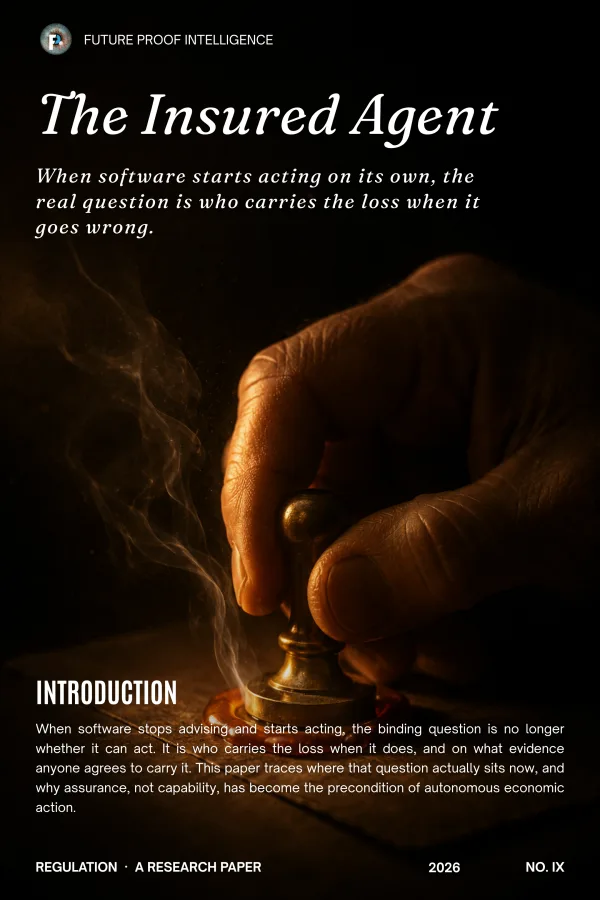
When software stops advising and starts acting with real economic consequence, the binding question is no longer whether it can act. It becomes who carries the loss when it does, and on what evidence anyone agrees to carry it. This paper traces the real 2026 state of that question. The European Union withdrew its bespoke fault based AI liability instrument and, in the same period, routed software and AI into a strict, no fault product liability regime with the claimant's path eased. Liability did not soften. It relocated and hardened. In parallel, ahead of the law and on its own clock, an AI insurance market formed: affirmative cover from a Lloyd's coverholder and a major reinsurer on one side, broad generative AI exclusions across general liability on the other. Both halves resolve to one missing object: a credible, continuous, portable attestation that a system is what it claims to be. No insurer underwrites what it cannot assure. Assurance, not capability, has become the precondition of autonomous economic action, and the reference for it is being set now, before it hardens.
Agency relocates the binding question
The moment software acts rather than advises, the question stops being how capable it is and becomes who carries the loss when it acts. That is a liability and insurance question, and no amount of capability work answers it.
Liability did not soften, it relocated
The bespoke fault based AI liability instrument was withdrawn while software and AI were pulled into strict, no fault product liability with the claimant's path eased. The most visible instrument was removed; the load bearing one was reinforced.
The probabilistic property flips from shield to exposure
Under a fault regime, the irreducibility of model error is the producer's strongest defence. Under strict liability the same property becomes the claimant's argument. The relocation moved AI from the regime where its defining trait protected it to the one where it indicts it.
The insurance market forms ahead of the law
Exposure does not pause for the legislative calendar. Affirmative AI cover and broad generative AI exclusions emerged in 2025 and 2026, while the public layer was still soft, because an underwriter cannot decline to have a view on a risk already being written.
Exclusion and affirmation are one motion
The general market excluding AI risk and the specialist market affirmatively covering it are not opposites. They are the two halves of a single hardening: a risk being forced from silent and unpriced into named, assessed, and separately underwritten.
Assurance is the precondition, not a feature
No insurer underwrites what it cannot characterise. The market built, in order, a standard, an audit against it, and a policy priced to the result. Insurability rests on the audit, the audit rests on the standard, so whether an autonomous system can act at all rests on what it can be credibly assured to be.
The structure grips identity, not capability
Capability resets every cycle and cannot be underwritten. Liability, audit, and underwriting all grip the slow, stable thing: whether the system is what it claims to be, continuously, with an accountable party behind it. The identity layer is where the structure comes to rest.
An uninsurable agent is not a powerful agent waiting for the market to catch up. It is a liability waiting for the first loss to land.
Request this research
The full paper, 30 pages, sent to you and yours to keep. We will know it reached someone serious.
One email. We do not add you to anything.