
Research · No. IV · Capital
Beyond Accumulation
Capital systems designed for trust, ecology, and interdependent renewal rather than extraction.
Accumulation is treated as the gravity of capital. It is not. It is a design, held in place by a few defaults, and it can be redesigned. This paper shows precisely what makes a renewal structure hold, and what makes one only look like it does.
What it finds- Whether capital extracts or renews is fixed by the claim structure, not by stated values.
- A renewal pledge only holds when it runs against the gradient, not with it.
- Most renewal structures only look like they hold. The paper shows what separates the two.
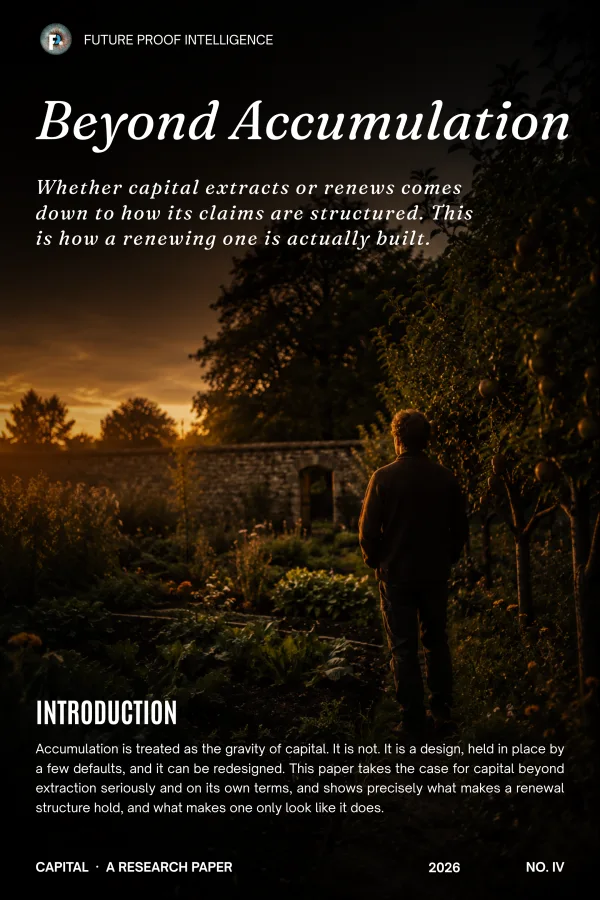
Accumulation is treated as the gravity of capital. It is not. It is a design, held in place by a legal default, a structural deadline, and an interpretive asymmetry, and it can be redesigned. This paper takes the case for capital systems beyond extraction seriously and on its own terms. It argues that whether a system extracts or renews is a property of the claim structure, who is entitled to demand what, on what trigger, and not of the character of the people inside it, which is why pledges and ratings fail predictably under pressure. It catalogues the instruments that already constrain the claim itself, several of them more than a century old, treats their failure modes without flinching, and shows the precise conditions under which return and renewal converge rather than oppose. It closes on the layer that is still missing: the thing that carries the meaning of a constrained structure across the transitions where good structures usually die. Grounded economics and institutional design, not sentiment. The reader finishes knowing exactly what makes a renewal structure hold, and what makes one only look like it does.
Extraction lives in the claim, not the character
Whether a capital system extracts or renews is fixed by who is entitled to demand what, on what trigger. Values do not transfer with shares. Entitlements do.
A pledge is a hand against a gradient
A behavioural promise placed on an unchanged claim structure works only while no one is testing it, and resumes its descent from a worse position the moment it is, because the pledge has by then been spent as cover.
The Faber problem
Where a renewal posture depends on a person occupying a control position that is still answerable to an unconstrained claim, the posture is a tenancy, not a structure. It lasts exactly as long as the tenant, and looks identical to success until it is too late.
Trust is a factor of production
Two economies with identical labour, capital, and land but different durable trust are running different production functions. Trust can only be produced by removing discretion, never by promising to forgo it.
Renewal is the cheapest input, not the price of virtue
A structure that renews its trust stock lowers its own cost of coordination on a compounding basis. The market prices the income statement and misses the cost structure a decade out. That gap is an arbitrage.
The single diagnostic
Genuine convergence of return and renewal has one signature: the horizon and the boundary cannot be unilaterally collapsed by any holder of the claim. If they can, it is alignment at the pleasure of whoever holds the collapse option.
Never ship a first half without its second half
Every failure of regenerative capital is a constraint installed without the mechanism that makes it hold. The field is full of visible first halves. The second halves are quiet, structural, and only tested when it is too late to add them.
Beyond accumulation is not a higher motive. It is a better structure, plus the thing that remembers what the structure is for after everyone who built it has gone.
Request this research
The full paper, 28 pages, sent to you and yours to keep. We will know it reached someone serious.
One email. We do not add you to anything.